Welcome to Your First Lesson on Azure Virtual Networks!
I’m Alex, your instructor, and throughout this course you’ll learn the core Azure Virtual Networking concepts you need to understand in order to pass the AZ-104 exam.
We’ll start with the fundamentals, from IP Addresses and CIDR Blocks, and gradually build up to more advanced concepts like Load Balancers and Firewalls.
By the end of the course, you’ll have a strong understanding of the Azure networking concepts you need in order to pass the Azure Administrator (AZ-104) exam.
With that said, let’s begin our first topic: Public IP Addresses.
What’s a Public IP Address?
An Public IP Address looks like this 192.168.1.10
It’s made up of four numbers with dots between them, and it represents the digital address of a computer in the world.
Every computer in the world connected to the internet has one. In fact, your computer has one too! Find out what’s your Public IP Address by clicking the button below:
Whenever two computers communicate across the internet, they do so through their Public IP Address. That’s how they know where to send the network packets.
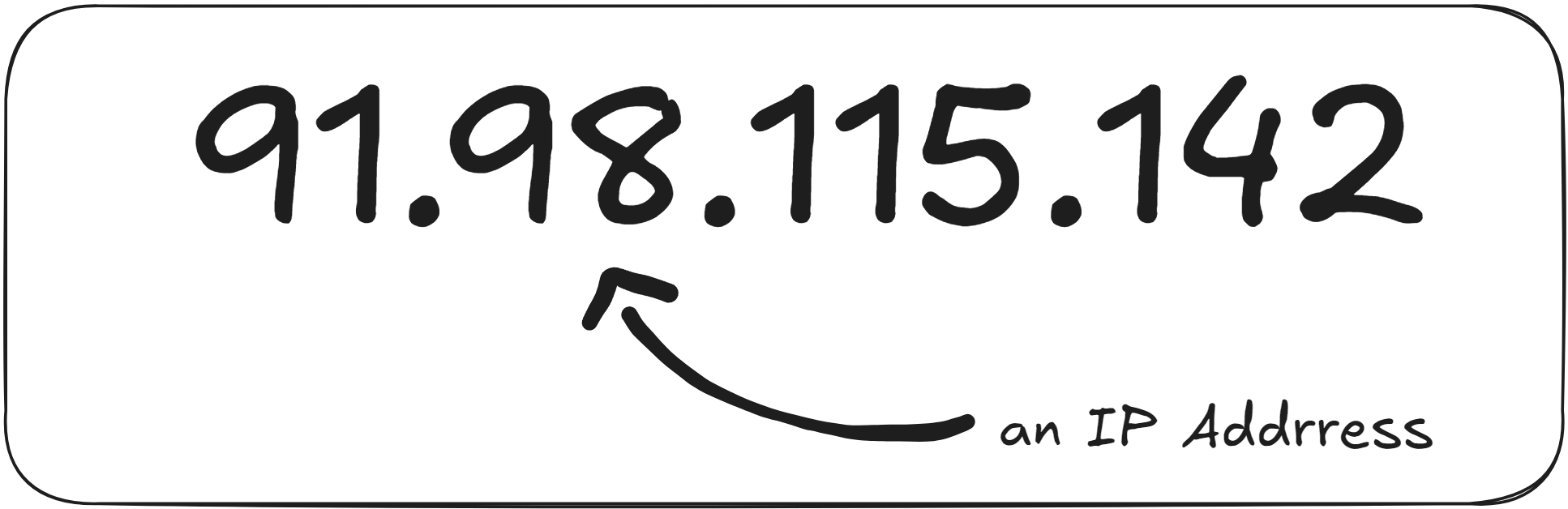
For example, your computer and the server hosting ZeroToArchitect (at 91.98.115.142) are communicating using their Public IPs.
Your Public IP Address is visible to any website you visit, and it can also reveal information about your current location, including your country and your city.
How many IP Addresses are there?
One thing that not be obvious at first, is that the number of possible IP addresses is not infinite. It has a hard limit, dictated by the way IP addresses are written.
An IP address (in a format called IPv4) is composed by 4 numbers separated by dots.
But there is a catch: Each number must be between 0 and 255.
That means that the lowest possible IP address is 0.0.0.0 and the highest is 255.255.255.255.
256 x 256 x 256 x 256 = 4,294,967,296
That’s roughly 4 billion unique Public IP Addresses.
When IPv4 was created back in the ‘80s, 4 billion IP Addresses sounded like a lot. But today, with over 8 billion people, and billions of devices connected to the internet, including phones, servers, routers and IoT sensors, we’ve far outgrown that amount.
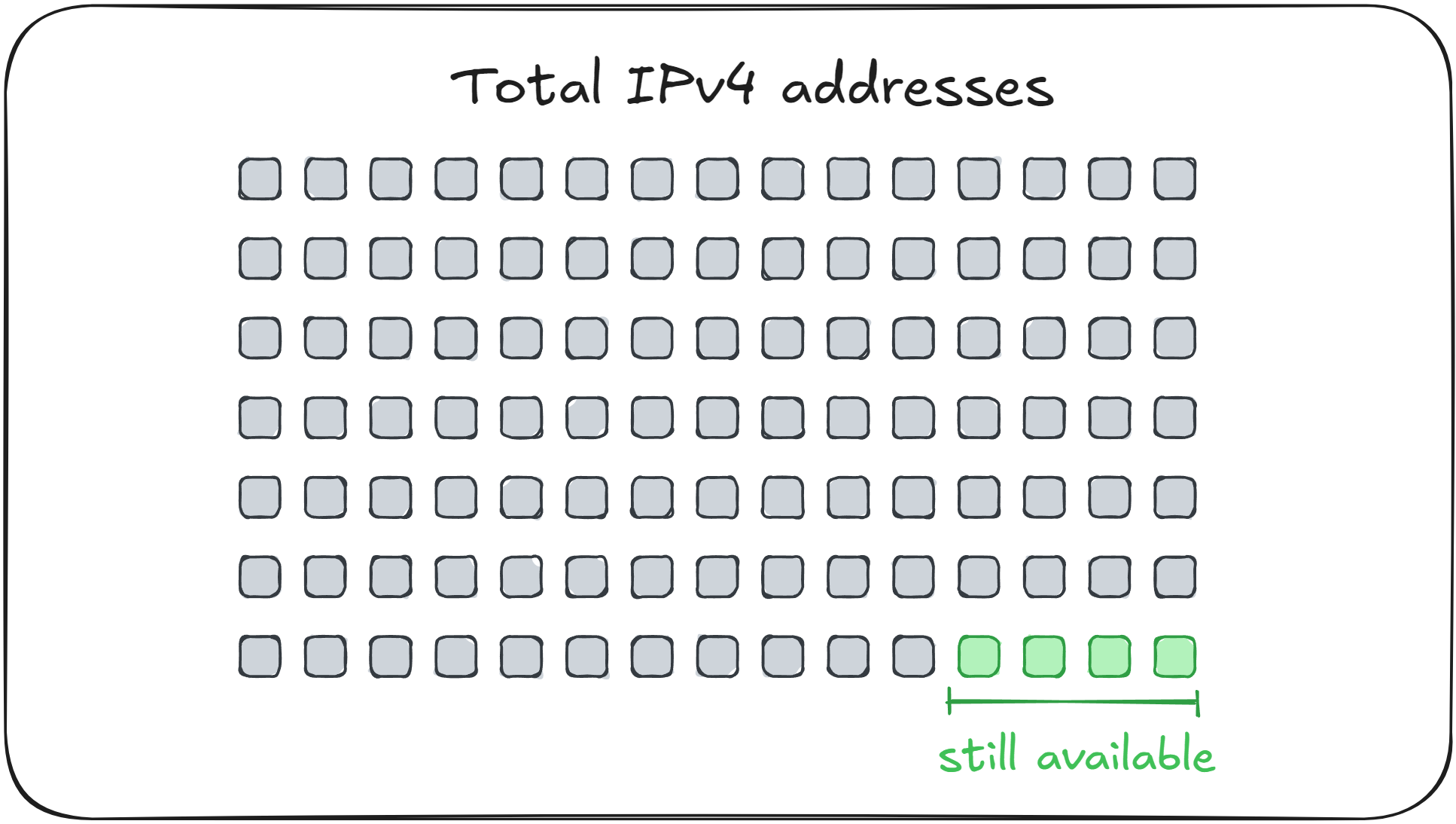
The internet has a big problem: it’s running out of Public IP Addresses. This event is known as IPv4 Exhaustion.
Lucky for us, some smart engineers in the '90s saw this problem coming and came up with two solutions to mitigate it:
- Private IP Addresses
- IPv6
Let’s learn more about them below.
You won't be asked to calculate the amount of available IP Addresses during your exam. Just remember that there are around 4 billion of them, and they are running out.
What are Private IP Addresses?
Private IPs were created as a way for computers to communicate within a network, without consuming a Public IP address.
Because these computers don’t have a Public IP address, they are not directly reachable from the public internet.
Think of an common home network:
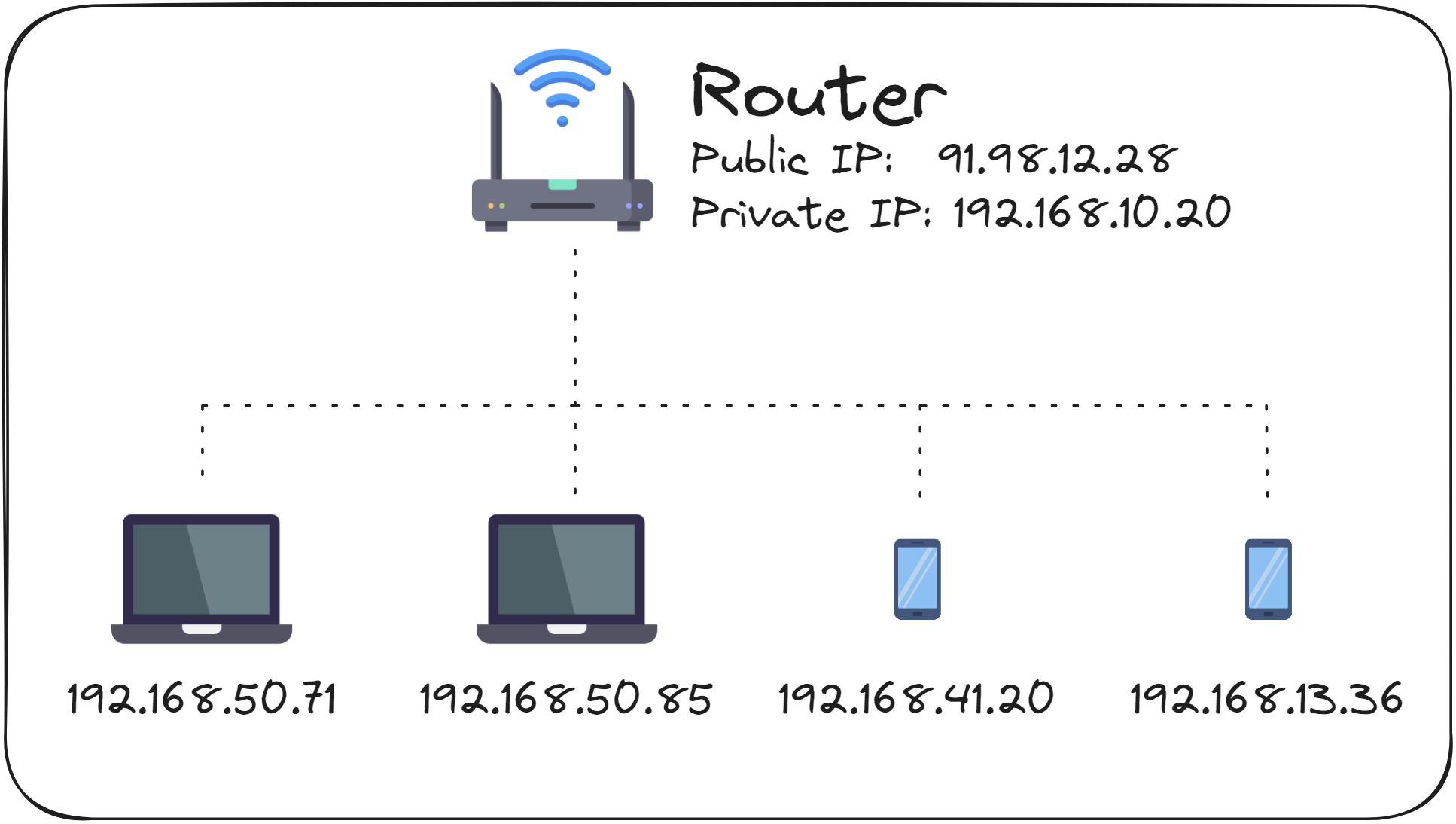
All your devices connect to a central device (such as a router), which directs traffic between them. This creates a Private Network that functions independently of the wider internet.
However, inside this Private Network, every device still needs a Private IP Address to communicate, but these don’t need to be globally unique, they only need to be unique within that specific home network.
This system allows millions of Private Networks worldwide to reuse the same Private IP addresses without conflict. For example, your phone connected to your home WiFi router could have the same Private IP address as my laptop connected to my home WiFi router.
|
IP Type |
User for |
Must be unique? |
|---|---|---|
|
Public IPs |
Communicate on the internet |
Yes, globally unique |
|
Private IPs |
Communicate within a local network |
Only within that network |
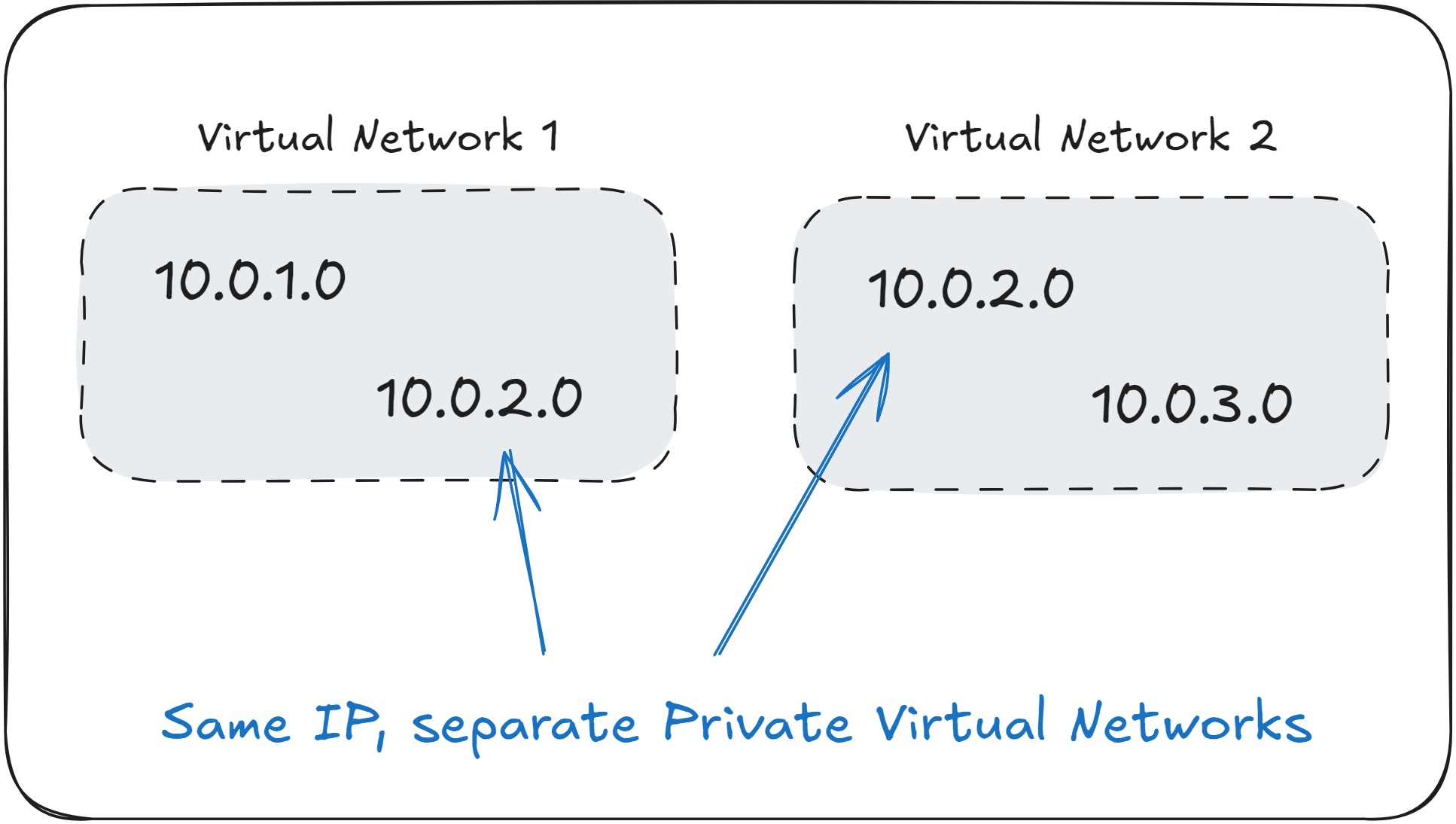
Because Private IPs never leave the network, you can safely reuse them across different networks. This is the foundation of what’s called a Private Virtual Network, the kind you’ll often work with in Azure.
The “Virtual” in “Virtual Networks” comes from the fact that these addresses are mostly stored in software. They’re not physical addresses you can see written on your machine.
When Private IPs were originally standardized, three specific IPv4 ranges were reserved so that devices could use them internally without consuming Public IP addresses. These ranges are:
- From
10.0.0.0to10.255.255.255(~16 million addresses) - From
172.16.0.0to172.31.255.255(~1 million addresses) - From
192.168.0.0to192.168.255.255(~65 thousand addresses)
You will use these ranges often when working with Virtual Networks in Azure, so it’s worth getting familiar with them.
For the AZ-104 exam, it’s important for you to recognize any IP address from the three ranges above as a Private IP address. Make sure to memorize the three ranges so you’re not caught off guard.
What is IPv6?
Eventually, even Private IPv4 ranges couldn’t keep up with the growth of devices connected to the internet. To solve this problem permanently, engineers designed the next generation of IP addressing: IPv6.
IPv6 looks quite different from IPv4. Here’s an example:
2001:0db8:85a3:0000:0000:8a2e:0370:7334
An IPv6 address consists of 8 hexadecimal numbers separated by colons (:), and it’s massive in capacity.
IPv4 uses 32 bits, while IPv6 uses 128 bits.
That gives us 2¹²⁸ addresses, which is enough to give more than a trillion addresses to every person on Earth.
There are also Private IPv6 addresses, called Unique Local Addresses (ULAs), which work the same way as Private IPv4, as they are used for internal communication where traffic doesn’t touch the internet.
Why Isn't Everyone Using IPv6 Yet? (Optional Deep Dive)
At this point, you might wonder: if IPv6 solves the problem, why hasn't everyone switched completely?
Because the internet’s infrastructure is deeply dependent on IPv4. Upgrading every device, router, and application worldwide takes time, and a lot of coordination.
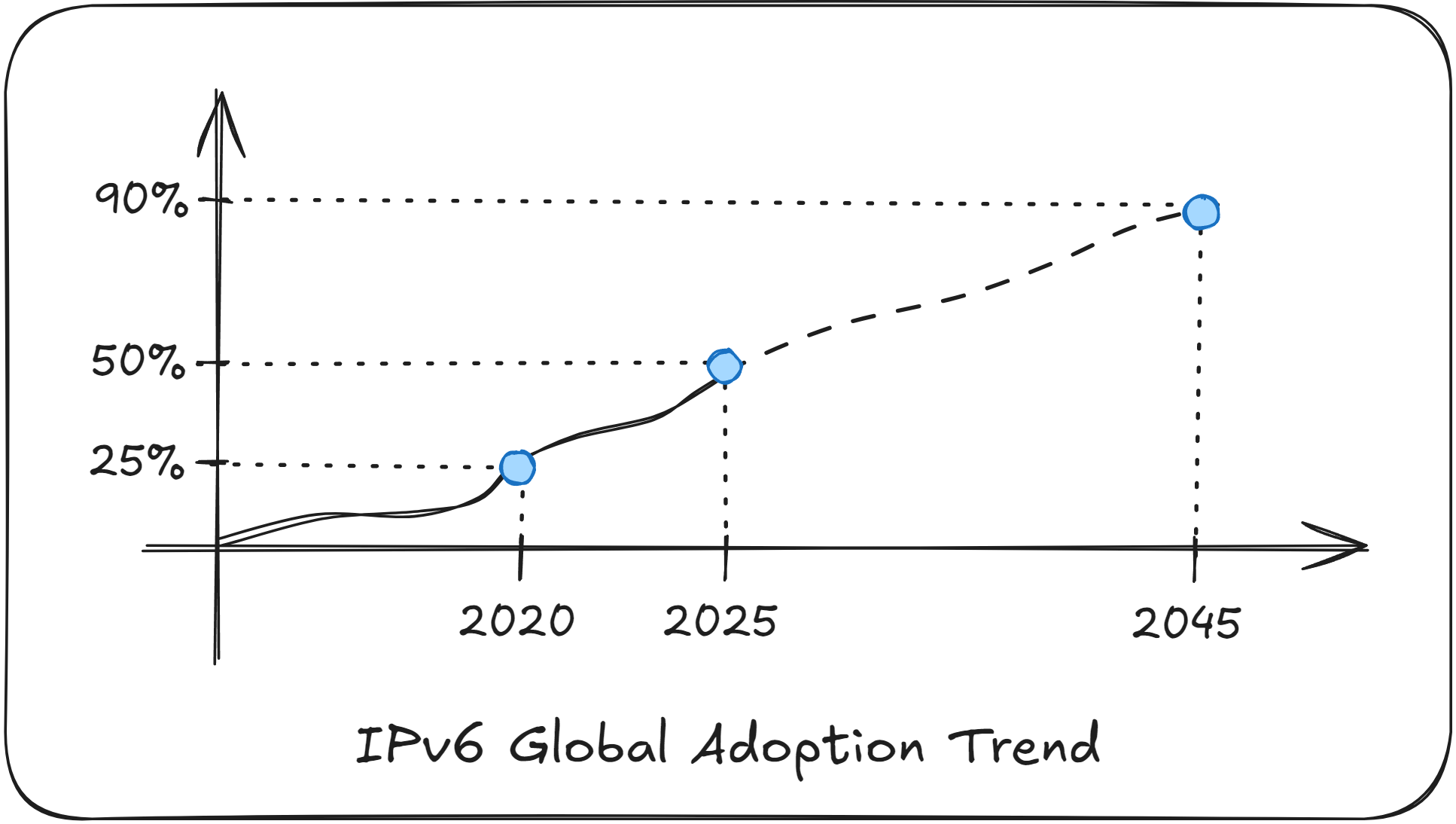
Here’s the current landscape:
- Around 50% of the world’s devices support IPv6 as of 2025
- That’s up from 25% in 2020
- Experts predict 90% adoption by 2045, but IPv4 compatibility will still be required by many systems
You’re not expected to know IPv6 in depth for the AZ-104 exam. Just remember that IPv6 exists to address IPv4 exhaustion, and that its adoption is still in progress.
What to remember for your exam
- An IP Address represents the virtual address of a device within a network (such as the internet).
- IP Addresses can either be Public (for internet traffic), or Private (for communication within a local network).
- IPv4 is the current standard, with around 4 billion possible IP Addresses. These are running out, causing IPv4 exhaustion.
- IPv6 was created in order to prevent IPv4 exhaustion, and a gradual migration of the world’s infrastructure is steadily taking place to support IPv6 addresses.
What's next?
To lock in what you’ve learned, take the short 8-question quiz for this lesson. It will help you test your understanding of IP Addresses before you move on.
In the next lesson, you'll learn how IP Addresses are grouped together to form Subnets, the building blocks of every Virtual Network.