
Free Azure Flashcards are now available on ZeroToArchitect

Introducing Flashcards: Free Spaced Repetition Scheduler
If you've ever studied for an Azure certification, you know the problem: you learn a concept on Monday and it's gone by Friday. Courses teach you the material, but retention is a different challenge entirely.
Today we're launching a built-in flashcards system on ZeroToArchitect to solve exactly that — and it's completely free for all members.
Why We Built This
Most learning platforms stop at content delivery. You watch the videos, read the material, maybe take a quiz. But decades of cognitive science research tell us that active recall — actively testing yourself on material — dramatically outperforms passive review.
The problem is that most students either don't use flashcards at all, or they end up juggling a separate app like Anki alongside their coursework. We wanted to eliminate that friction entirely.
How It Works
Flashcards on ZeroToArchitect are organized into decks aligned with specific certifications and exam topics. Each card has a front (the prompt) and a back (the answer), and supports rich content including code snippets, formatted text, and diagrams.
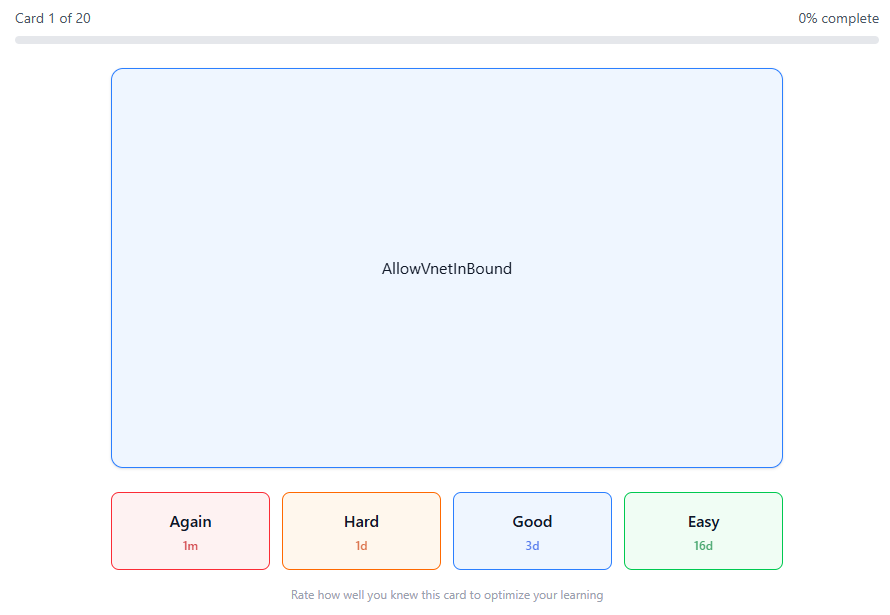
When you study a deck, cards are presented one at a time. Click to flip and reveal the answer, then rate your recall:
- Again — didn't remember it
- Hard — remembered, but it was a struggle
- Good — remembered with reasonable effort
- Easy — knew it instantly
Each button shows you the exact interval until the next review before you press it, so you can make an informed decision.
Powered by FSRS-5
Under the hood, the scheduling is powered by FSRS-5 (Free Spaced Repetition Scheduler) — the same research-backed algorithm used in Anki's latest scheduler. Unlike simpler systems like Leitner boxes or SM-2, FSRS uses mathematically-derived optimal scheduling that tracks both the stability and difficulty of each card individually.
What this means in practice:
- Cards you find easy appear less often, saving you time
- Cards you struggle with appear more frequently, right before you'd forget them
- A fuzz factor prevents all your reviews from clustering on the same day
- The default retention target is 90%, which you can adjust based on your needs
The result is that you spend the minimum amount of time reviewing for the maximum amount of retention.
Progress Tracking
Every study session ends with a detailed summary showing:
- Ease distribution — a breakdown of how you rated cards (Again/Hard/Good/Easy)
- Pack health shift — how many cards progressed in maturity, how many relapsed, and how many new cards you learned
- Per-card details — every card you reviewed with its next review date
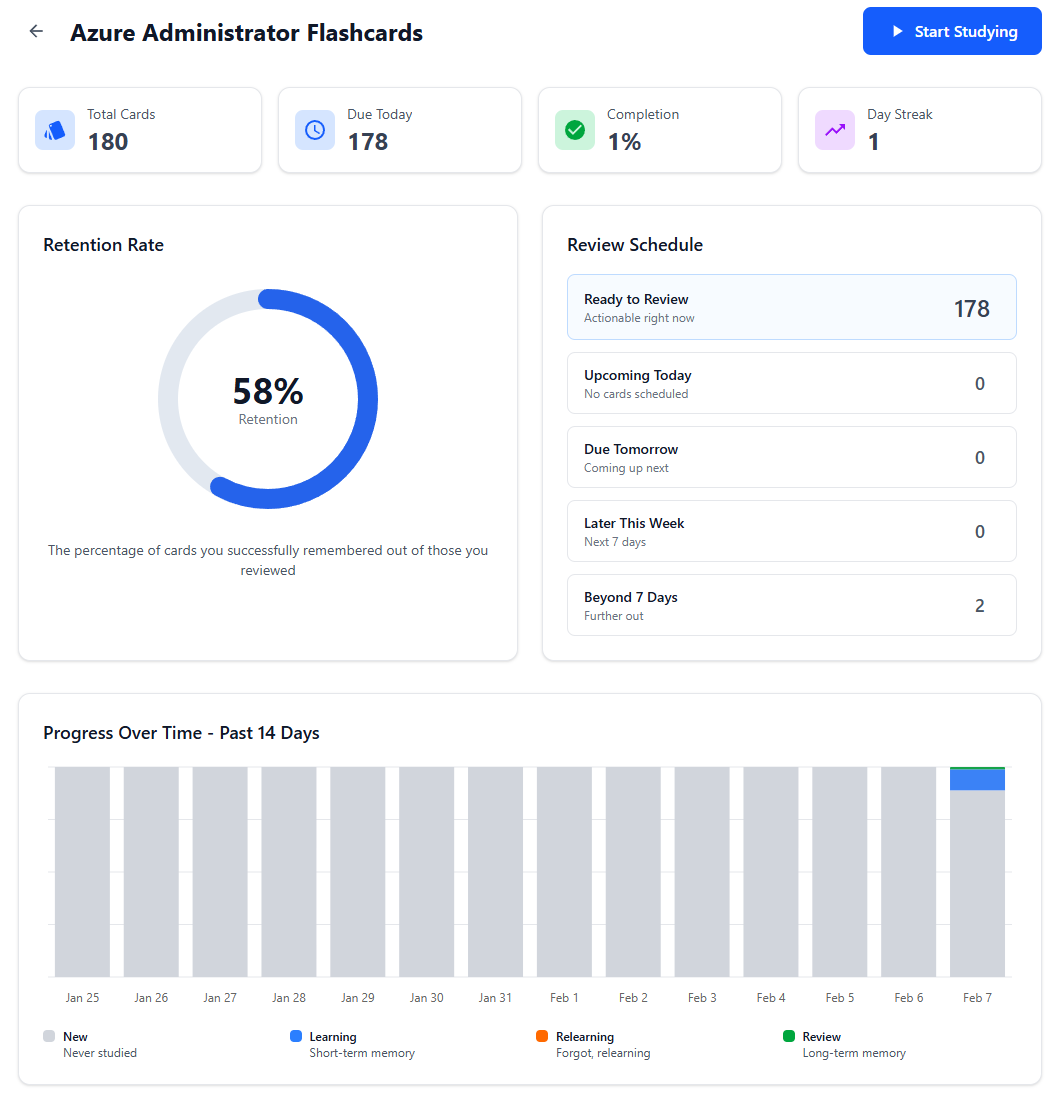
Beyond individual sessions, the flashcards dashboard tracks:
- Retention rate with a visual radial chart
- Study streak — consecutive days studied, including your current and longest streak
- 14-day progress history — a stacked bar chart showing how your cards are moving through learning stages
- Review schedule — what's due now, later today (with countdown timers), tomorrow, and this week
Flashcard decks are linked to certifications on the platform. This means the cards you study are directly relevant to the exam you're preparing for — not generic computer science trivia. Cards are tagged by topic category so you can see exactly which areas you're strong in and which need more work.
Completely Free
There's no paywall, no trial period, no premium tier required. If you have a ZeroToArchitect account, you have access to all flashcard decks.
Also, new decks are being added regularly. If there's a certification or topic area you'd like to see covered, let us know in the Discord community or reach out directly.
Happy studying!
Alexandru Tepes,
Founder of ZeroToArchitect
Get Started
Free Azure Flashcards
Want to pass your next certification?
Practice with independently written, objective-aligned questions. Build understanding, identify weak areas, and plan your next study step.
Azure Administrator
For IT admins managing Azure infrastructure. Covers identity, storage, networks, and compute resources - essential for administration and operations roles.
Azure Solutions Architect
For architects designing cloud solutions on Azure. Covers infrastructure, security, data platforms, and business continuity - essential for leading enterprise cloud initiatives.
Azure Fundamentals
Entry-level certification for beginners in cloud computing. It covers core Azure concepts, services, security, and compliance - ideal for both technical and non-technical roles wanting a foundation in Azure.
Azure Network Engineer
For network engineers managing Azure networking. Covers hybrid connectivity, routing, security, and private access to Azure services - critical for enterprise network infrastructure.
Azure Security Engineer
For security professionals protecting Azure environments. Covers identity management, platform protection, security operations, and data security - vital for cloud security roles.
Azure AI Fundamentals
Fundamentals certification for understanding AI concepts and building simple solutions with Microsoft Foundry. Covers responsible AI, generative and agentic AI, speech, vision, language, and content understanding.

ML Ops and Gen AI Solutions
Advanced certification for designing and implementing production AI solutions. Covers RAG architectures, model evaluation, fine-tuning, orchestration, observability, and responsible AI patterns in Azure.